
We Analyzed 6,000+ LinkedIn Profiles. Here Is the State of the Average Profile in 2026
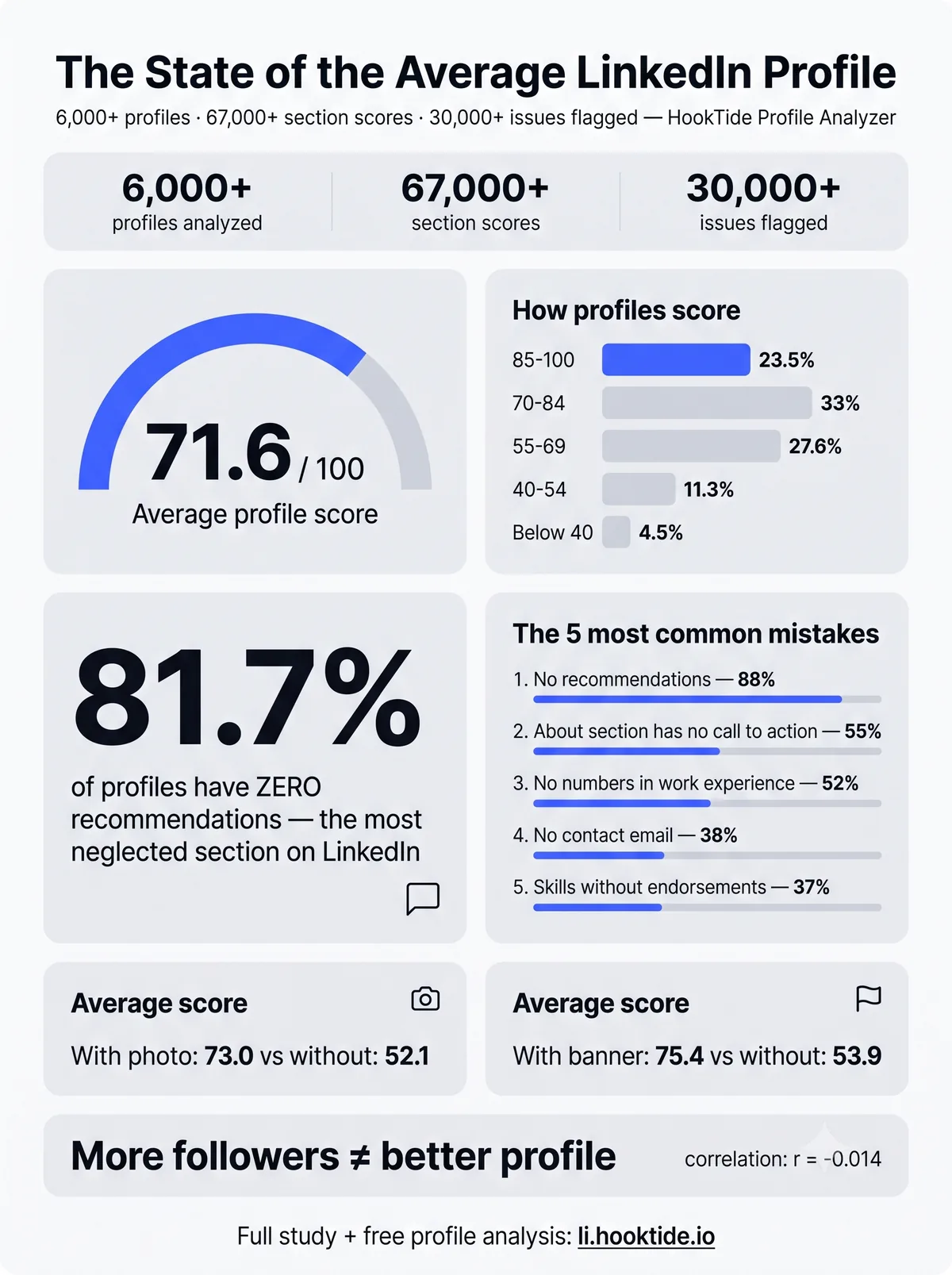
The average LinkedIn profile scores 71.6 out of 100. Only 23.5% of profiles reach the top band (85+), and 81.7% have received zero recommendations. Those numbers come from more than 6,000 profile analyses run through HookTide's LinkedIn Profile Analyzer between November 2025 and July 2026: over 67,000 individual section scores and more than 30,000 flagged profile issues.
This post breaks down the LinkedIn profile statistics that matter: what a typical profile looks like, which sections people get right, which section almost everyone ignores, and what separates the top scorers from the rest.
Where this data comes from
HookTide's LinkedIn Profile Analyzer scores public LinkedIn profiles across 11 sections, from the headline and about section to experience, skills, and recommendations. Each analysis produces a 0-100 score, section scores, and a list of flagged issues.
This study covers more than 6,000 completed analyses of nearly 5,900 distinct profiles, run between November 30, 2025 and July 16, 2026. Across the dataset, that adds up to more than 67,000 individual section scores and over 30,000 flagged issues.
One honest caveat before the numbers: everyone in this sample chose to run a profile analyzer. These are people who already care about their LinkedIn presence. Across all of LinkedIn, the real averages are likely worse than what you see below.
What does the average LinkedIn profile look like?
The typical profile in our data:
- Scores 71.6 out of 100 (median 72)
- Has a 105-character headline
- Lists 35 skills and 5.3 work roles
- Has 809 followers and 778 connections (medians)
- Has received 0.59 recommendations, and in 81.7% of cases, none at all
- Is set to open-to-work 19.2% of the time
What is a good LinkedIn profile score?
Here is how the analyzed profiles distribute across score bands. For what each band means for your own goal, see what counts as a good LinkedIn profile score.
| Score band | Share of profiles | What it means |
|---|---|---|
| 85-100 | 23.5% | Profile works around the clock |
| 70-84 | 33.0% | Fundamentals right, sharpening left |
| 55-69 | 27.6% | Solid but leaking opportunities |
| 40-54 | 11.3% | Underperforming |
| Below 40 | 4.5% | Working against you |
The median profile sits at 72: decent, not compelling. If you want to know where you land, you can get your own LinkedIn profile score, the same 0-100 measure used in this study.
Which profile sections are strongest and weakest?
Averaging each section's score as a share of its maximum points reveals a clear pattern:
| Section | Average score (% of max) |
|---|---|
| Education | 92.2% |
| Visual (photo and banner) | 88.7% |
| Headline | 72.3% |
| Technical settings | 67.0% |
| Certifications | 61.0% |
| About section | 53.9% |
| Skills | 49.4% |
| Experience | 42.2% |
| Languages | 36.7% |
| Recommendations | 11.8% |
Photos, banners, and education are mostly solved problems. The middle of the profile, where the persuasion happens, is where people fall short: about sections at 53.9%, skills at 49.4%, and experience at 42.2% of their potential.
And then there is the bottom of the table.
The most neglected section on LinkedIn: recommendations
Recommendations average 11.8% of their possible points, the lowest of any section by a wide margin. 81.7% of profiles have received zero recommendations. It was flagged in 88.3% of all reports, making it the single most common issue in the entire dataset.
This is also the cheapest fix on the list. A recommendation costs nothing except asking. Three short messages to former colleagues or clients put you ahead of 4 out of 5 profiles on a section most people never touch.
What are the most common LinkedIn profile mistakes?
The ten issues our analyzer flags most often, by share of profiles affected:
- Zero recommendations received (88.3%)
- About section has no call to action or contact info (54.9%)
- Experience has no quantifiable results (51.8%)
- No contact email visible (38.0%)
- Skills have zero or few endorsements (37.4%)
- One or more roles missing a description (27.3%)
- No banner image, or a weak one (16.2%)
- Generic, job-title-only headline (13.8%)
- No skills listed at all (13.7%)
- No certifications listed (13.4%)
The average report flags 5 issues. Numbers 2 and 3 deserve special attention: more than half of all profiles describe their work without a single metric, and more than half never tell the reader what to do next. If you want these checks run on your own profile, that is what the free LinkedIn profile checker does.
Do followers make your profile better?
No. Follower count shows near-zero correlation with profile score (r = -0.014 across the full dataset). Connections correlate weakly (r = 0.237).
You can have 50,000 followers and a profile that loses every visitor in the first five seconds. Audience size and profile quality are different jobs, and the data says people who did one rarely did the other.
What separates the top-scoring profiles?
Three patterns stand out in the data:
They write longer, structured about sections. About-section length has the strongest content-to-score relationship we found (r = 0.556). This is a correlation, not proof that padding helps; but top profiles consistently use the space, and weak profiles leave two generic lines.
They finish the visuals. Profiles with a photo average 73.0 versus 52.1 without one. Profiles with a banner average 75.4 versus 53.9 without. To be clear about what this means: profiles missing a photo or banner tend to be unfinished in other ways too, so this gap is correlation, not a promise that a banner alone adds 21 points. If a missing headshot is what is holding yours back, an AI service like HeadshotPro gets you a studio-quality set from selfies. (Affiliate link: we may earn a commission if you buy.)
They ask for something. Only 43.7% of about sections contain any call to action, and 9.4% include contact info. High scorers tell the reader what to do next; average profiles just end.
What should you fix first?
Based on what the data flags most and what moves scores most, in order:
- Ask 3 people for a recommendation this week. You will pass 81.7% of profiles on the most neglected section on LinkedIn.
- Add numbers to your two most recent roles. More than half of profiles have none. "Cut onboarding time from 3 weeks to 4 days" beats any adjective. Turning duties into outcomes walks through the rewrite.
- End your about section with an ask. Message me, book a call, follow, apply. Only 43.7% of about sections contain any call to action; the rest leave the reader with nothing to do. Our LinkedIn about section examples show what that looks like in practice.
If you would rather work through the whole profile in order, how to improve your LinkedIn profile covers the sequence, and the most common LinkedIn profile mistakes covers what the analyzer flags most. For the headline specifically, which is the first thing anyone reads, see our LinkedIn headline examples.
Or skip the guesswork: run your profile through the free LinkedIn profile analyzer and get your own score, section breakdown, and prioritized fix list in about a minute.
Frequently asked questions
What is the average LinkedIn profile score? Across the more than 6,000 profiles we analyzed, the average score is 71.6 out of 100 and the median is 72, measured on HookTide's 11-section rubric.
How many LinkedIn profiles have recommendations? Only 18.3% of profiles in our sample have received at least one recommendation. The average across all profiles is 0.59 recommendations received.
Does follower count affect your LinkedIn profile score? Not in our data. Followers show near-zero correlation with profile quality score (r = -0.014). Connections show a weak positive correlation (r = 0.237).
Methodology: more than 6,000 completed analyses of nearly 5,900 distinct public LinkedIn profiles, November 30, 2025 to July 16, 2026, scored by HookTide's LinkedIn Profile Analyzer across 11 profile sections. All statistics are aggregates; no individual profile data is published. Sample skews toward people actively working on their LinkedIn presence.